
CABARET
CABARET music by John Kander, lyrics by Fred Ebb, book by Joe Masteroff.
Part of The University of Texas at Austin's Subscription Season. Austin, TX. 2026.
Director - Rodolfo Robles Cruz
Choreographer - Angel Blanco
Music Director - Ellie Shattles
Dramturg - Georgia Beckmann
Scenic Design - Joshua Martin
Media Design - Nitsan Scharf
Light Design - KP Pierce
Costume Design - Violet Clemons
Sound Design - Austin Brion
Stage Manager - Sarah Apple
Assistant Director - Julia Kreutzer
Directing Apprentice - Blake Persyn
Intimacy Director Andy Grapko
Dialect Coach - Alison Vasquez.
Cast: David Gonima, David Gonima, Hunter Purvis, PennyLou Zimmerman,
Bella Friedman, Ericka Pugliese, Katelyn Quintanilla, Heavyn Carter, Katelyn Doyle, Natalie Tran, Brandt Agosto-Medina, Christian Ortega, Diego Rodriguez, Giovanni Ledezma, Ella Eavenson, Harry Rosenthal, Connor Burk, Ethan Sebree, Shaya Harris, Roman Losa, Lucas Edwards (recorded voice)
Musicians: Trevor Detling, Jeff Freeman, Kurt Kumme, Jake Lampe, Kathryn Orr, Kris Rogers, Ellie Shattles, Zack Varner, Jeff Elliot, Andrew Malay, Demetrius Thornton, Arnie Yanez
Photos: Gavin Strawnato / Dominic Plate / Sarah A. Navarette courtesy of The University of Texas at Austin.


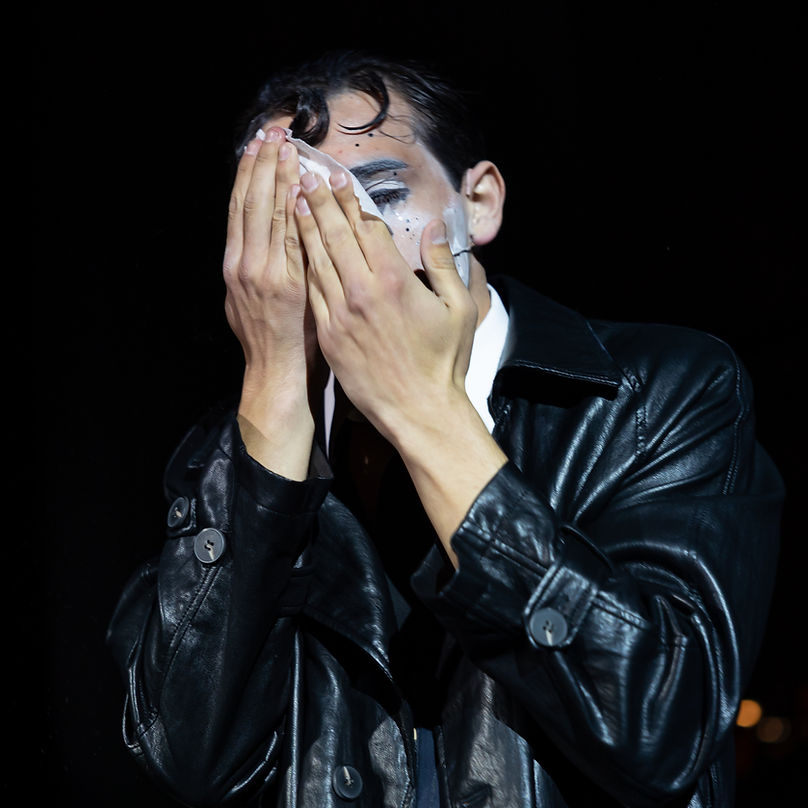
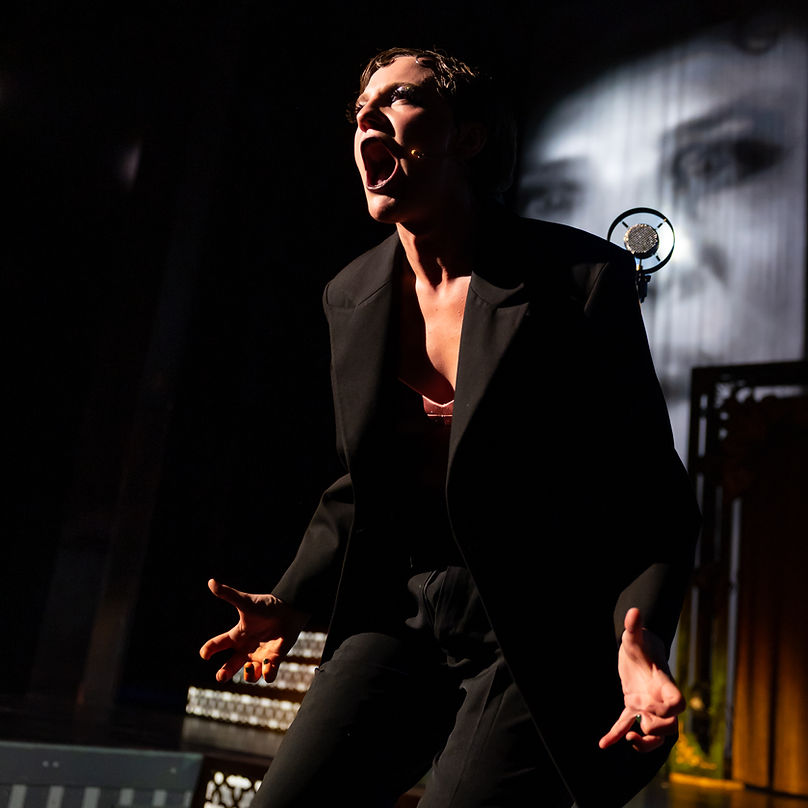
"In a theatrical landscape crowded with reinventions, UT’s Cabaret finds its power in precision."
- Sabrina Wallace, BROADWAYWORLD.COM
Inside the making of UT Theatre & Dance's 'Cabaret', an Audio Story by Ethan Rubenstein & Drew Kampf-Sullivan.
The Many Histories of Cabaret: A Dramaturg's Process, a reflection from PhD Candidate and Cabaret Production Dramaturg Georgia Beckmann.
Cabaret digital program found here.

The Approach
A little over a decade ago, I was a high school student, ready to step into the next portion of my life. In searching for what that would be, I attended a production of Cabaret at California State University, Fresno. The performance — directed by J. Daniel Herring, who would later become a friend and mentor — was liberated, unflinching, and charged. At the time, the U.S. was in the midst of a pivotal national conversation about marriage equality, with the legalization of same-sex marriage being debated in courts across the country. J. Daniel’s production of Cabaret became a vehicle that centered queer liberation, fueled by a collective rage stemming from a sort of purgatory — awaiting a landmark decision, which would come just months later in Obergefell v. Hodges.
It’s worth remembering that when Cabaret premiered on Broadway in 1966, the Vietnam War was dramatically escalating, leading to political division and protest. The 1972 film adaptation, directed by Bob Fosse and starring Liza Minnelli, arrived amidst the ongoing Vietnam War, the Watergate scandal, and the rise of second-wave feminism. The 1998 Broadway revival, directed by Sam Mendes, emerged in the aftermath of the AIDS crisis, during the “don’t ask, don’t tell” era of U.S. military policy, and ran during a time of backlash against queer visibility in public life.
The arts at large often serve as a timestamp in our cultural landscape. Theatre, in particular, is the practice of archiving these timestamps in our bodies — digesting them, wrestling with them, and earnestly sharing them.
A decade ago, at seventeen, I was taken by the glamour, the frustration, and the unflinching vision of J. Daniel’s production. I thank my former mentors for operating from a place of fearlessness, liberation, and strength. I’m honored now with the task of interpreting Cabaret, and I hope to celebrate my mentors — past, present, and future — through the tenacity I bring to this production. A tenacity supported fully by the production team I am blessed to be working with.
I often reach back to access my own body archive and place myself in the past, watching this production to see how he — younger Rodolfo — would feel watching the Cabaret we’ve created. What timestamp will people remember?
“I am a camera with its shutter open, quite passive, recording, not thinking… Someday, all of this will have to be developed, carefully printed, fixed.”
— Christopher Isherwood


